🌐 Eventual Consistency
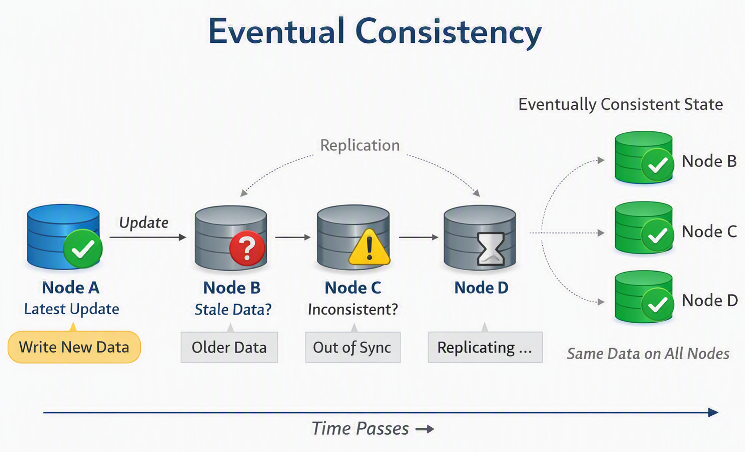
Eventual consistency is a consistency model used in distributed systems (especially NoSQL databases) where updates to data are not immediately visible across all nodes. Instead, the system guarantees that if no new updates are made, eventually all nodes will converge to the same state.
🔑 Key Idea
- When you write data to one node, other replicas may not reflect the change instantly.
- Over time (seconds, minutes, or longer), replication ensures all nodes agree.
- During this window, clients may see stale or inconsistent data depending on which node they query.
📖 Example
Imagine a social media feed stored across multiple servers:
- You post a new update.
- Server A shows it immediately.
- Server B may take a few seconds to replicate the change.
- Eventually, all servers show the same feed — but not instantly.
✅ Pros
- High Availability: System responds even during network partitions.
- Performance: Faster writes and reads because strict synchronization is avoided.
- Scalability: Works well across globally distributed data centers.
⚠️ Cons
- Temporary Inconsistency: Users may see outdated or conflicting data.
- Complex Conflict Resolution: Developers must handle cases where two updates happen simultaneously.
- Not Suitable for Critical Systems: Banking or healthcare require strong consistency.
🏆 Best Practices
- Use eventual consistency for non-critical, high-volume systems (social media, product catalogs, IoT).
- Combine with timestamps or versioning to resolve conflicts.
- For mixed workloads, adopt hybrid models (e.g., strong consistency for financial transactions, eventual consistency for analytics).
📌 Key Takeaway
Eventual consistency is a trade-off: you gain availability and speed at the cost of temporary accuracy. It’s a cornerstone of BASE systems and ties directly into the CAP theorem and PACELC theorem